
The Firmware Hub · FM-1 · Hortator (Bluetooth)
Hortator (Bluetooth)1.0.1
Hortator's Bluetooth build: the same eight-track drum machine, plus Bluetooth MIDI for a BLE keyboard or clock, or the M-VAVE SMC-Mixer as a mixer for the eight tracks. Reads the plain version's projects.
Text by the hub. Your firmware? Write it yourself, in your repository.
About it
- Engines
- Analog / VASamplerIts own: drum models (808/909/Plaits ports) · SAMPLE (IMA ADPCM sample sets) · ACID (303-style bass voice)
- Runs on
- FM-1 · Browser ↗
- Release
- 1.0.1 · released 3 Nov 2026 · on the hub since 28 Oct 2026595 KB · what's new
- Licence
- GPL-3.0 · source ↗ · copy on the hub
- Flash chip
- Every FM-1, the newer chip
0xB36014too - Identity
FM-1_900what it reports over USB while it runs- Build
- Built by its maker, not signed
- Popular
- ↓ 87 installs via the hub · ★ 59 on GitHub
Ratings
More by DEADACTIVE
Like Hortator (Bluetooth)


Changelog
What changed, version by version17 versions
Unreleased
1.0.1 - 2026-11-03
- Newer FM-1s save again: FM-1s sold recently come with a different flash chip of the same size. Hortator now recognises it, so projects, presets and settings are saved on these units instead of staying in memory with a flash error.
1.0.0 - 2026-11-03
- More LFO destinations: a track's LFO can now also move SRR, DST, the CHO, DLY and REV sends, the INSERT's MIX and its three values A, B and C (shown by the INSERT type's names). They are in the DEST list after F.RES, so projects, presets, step locks and MIDI LEARN keep their meaning, and nothing changes until an LFO is routed to one.
- Fewer dropouts under heavy load: the FM-1 now stops a voice when an audio block takes more than 85 % of its time (it was 95 %), so a sudden peak no longer runs past the deadline and drops out. Very heavy kits may lose a voice a little sooner.
- Web editor: edit the FM-1 from the browser, on the Hortator site under Editor, with the FM-1 connected by USB. Click Connect: the page asks the FM-1 who it is, so it finds it even when the computer still shows it under an old name such as "Felucca" or "FM-1". Other MIDI gear gets nothing unless you click Search other MIDI ports; an FM-1 that does not answer (the official firmware, Felucca or an older Hortator) gets a link to the installer.
- Sound: the selected track's pages (SOUND for its model, LAYER, FILTER, FX, INSERT, SRR, RESON, SLICER, LFO 1 and 2, DEST) and the globals, among them the DLY, REVERB (ROOM, SPRNG, HALL) and CHORUS pages, each knob with the FM-1's own text. Both ways: turn a knob on the FM-1 and it moves in the page; move it in the page and the FM-1 plays it. Choosing a track in the page selects it on the FM-1, and the other way round.
- Presets: the 151 factory presets (in their three banks), loaded onto a track with a click. The user presets as a list: rename, reorder, delete, save a track's sound into a slot, back up to a file, open a file and write the list to the FM-1 (this one or another). The names live in the page and its files; the FM-1 keeps showing "MODEL NN".
- Projects: A–D as saved, with unsaved changes marked. Back up a project (with its locks and variations) or everything (the user presets and all four projects) to a file; restore a project into any slot, on this FM-1 or another; restore everything; copy a project to another slot. A backup holds what is saved on the FM-1: SAVE first to include changes not saved yet (the page says so). Restoring asks first and says what it replaces.
- Patterns: every track's 64 steps in each variation of a slot (on / off, NOTE, PROB, RATCH, ACC, NUDGE, FILL / !FILL, SLIDE / TIE on ACID), editable; editing another variation makes the FM-1 switch to it, as its key would. NUDGE is a slider from -50 to +50 with the FM-1's own reading (+25, -10), and a nudged step has a mark in the grid on the side it moves to, as on the FM-1. The locks of each step, editable and clearable. SAVE from the page.
- Remote cue: click a slot or a variation to queue it, exactly as the cue keys do, with the same refusals.
- Copy a variation: from this slot, another slot or a backup file into a variation of the loaded slot, with the source's locks if you want them; every step's NUDGE comes along. Locks the FM-1 cannot hold are refused before anything changes.
- Restores (user presets, projects) only while the FM-1 is stopped. Meanwhile it shows RESTORING and its PLAY, cue keys, LOAD, SAVE, the TOOLS screen's pastes, DUPLICATE and CLEAR and a held step's knobs wait, and nothing is recorded. A power cut during a restore leaves the old or the new project whole.
- Backup files made by an earlier test build of the editor (before NUDGE) still restore, every step at NUDGE 0, and their variations can still be copied. Files made now hold the new project format: an FM-1 still on an older firmware refuses them with "UPDATE THE FM-1 FIRST" and keeps what it has.
- While the FM-1 plays with SYNC (MIDI clock out) on, the page asks before a big transfer: clock out may jitter, stop first?
- USB only, not over Bluetooth (the Bluetooth version has the editor over USB too). Chrome, Edge or Opera on a computer or Android; Firefox after its permission prompt; not Safari (it has no Web MIDI).
- A firmware update always comes first: while the web installer runs, the editor goes quiet, and it connects again afterwards (or click Reconnect). Other SysEx a DAW sends does not interrupt the editor. One browser tab runs the editor at a time: another tab offers "Use here".
- SAMPLE: ATK, SUS, REL and LOOP. The SAMPLE model has a fifth SOUND page with an envelope and a loop. ATK fades the hit in (0 to 2 s). SUS 0 plays the sample once with DECAY, exactly as before; above 0, the sound falls to that level and holds while the note is held, then REL fades it out. A step holds its note for one step of the track, longer through the TIE steps after it; a key in KEYS mode, a track's key or a MIDI note holds it until you let go. LOOP plays the part between START and END again and again: FWD (with a short crossfade, so the seam does not click) or PING (forward and back; loops up to about a quarter of a second at 44.1 kHz, longer ones play FWD). With ATK 0, SUS 0 and LOOP OFF every hit sounds as before. The four knobs take MOTION, step locks and MIDI LEARN, are saved with projects and in USER presets (still 96 slots), and the web editor shows and saves them. A factory SAMPLE preset sets them back to their defaults. In a user sample set START, END and LOOP work within whichever sample SLOT plays, over that sample's own length.
- SAMPLE: PLAY KEY or CHOP. A new SAMPLE knob, PLAY (SOUND page 4, after CHOKE and PRIO). KEY is how it always played: in KEYS mode the keys play the chosen SLOT's sample up and down the keyboard. CHOP turns a set of samples (a chopped loop, a kit) into something you play: in KEYS mode the 16 white keys play samples 1 to 16 on any octave, each at its own pitch (TUNE still shifts them all); a key past the set's samples and the black keys play nothing, and the screen shows which one played (
CHOP 5/12). Recorded live or with step record, each step remembers its sample, so the pattern plays the same chops back. MIDI notes pick a sample too: C4 is sample 1, C#4 sample 2 and so on, again every 16 notes. PLAY takes step locks, MOTION and MIDI LEARN and is saved with projects and in USER presets. KEY is the default, so everything sounds as before. - SAMPLE: LOOP LOOPI and ONE, and CUT. LOOP has two more choices. LOOPI loops between START and END forever: the end of the note and REL do nothing, the sound stays at its level (the full level, or SUS's) until the track's next hit, a choke or STOP (STOP ends it, so nothing keeps sounding). ONE plays the sample from START to END whatever the note's length, with no release. CUT (next to PLAY): ON makes each new hit cut the one still sounding, with a short fade, chops included; OFF (the default) lets them overlap as before. Both are saved with projects and in USER presets, and take MIDI LEARN.
- Web editor: Samples. A new Samples tab loads your own sounds into the three user sample slots (USR1 holds 80 KiB, USR2 and USR3 48 KiB each) and shows what each one holds: its name, length and how full it is. Open a WAV (or an AIFF your browser can open), trim its start and end on the waveform, normalize it if you like and choose the sample rate (the file's own up to 44.1 kHz, or a lower one when the sound is too long for the slot; the page shows the length you get). The preview plays exactly what the FM-1 will play. The upload shows its progress and can be cancelled; the FM-1 shows UPLOAD USR1 meanwhile and must be stopped. Until an upload is complete the slot reads as empty, so a cancelled upload, a pulled cable or a power cut leaves the slot empty, never half a sample. Each slot can also be listened to, backed up to a file and restored (into any slot), renamed and cleared. A sample never spills past its slot: the projects' variations and lock banks next to USR2 and USR3 stay safe, and the firmware update leaves the samples alone.
- Web editor: sets of up to 16 samples. Each user sample slot (USR1, USR2, USR3) now holds a set of up to 16 samples instead of one: the SAMPLE model's and the LAYER's SLOT knob picks among them (
2/5), in the order the page lists them. The Samples tab shows each set's samples with their names, lengths and sizes, how full the slot is and how much room is left before you add one. Add a sound file as the set's next sample, put it in place of one, or replace the whole set; play each sample as the FM-1 plays it, open it again to trim, normalize or resample it, move it up or down, rename it or delete it (these wait for Write, and can be undone until then). Every write sends the whole set with the FM-1 stopped; if it is cancelled or fails, the slot is left empty, never half a set, and the page keeps the set so you can write it again or save it to a file. The samples keep their names in the set. Sets and single samples from before load and play as they did. - Web editor: Chop. Cut a long sound (a drum loop, a phrase) into samples: Auto finds its hits (with a sensitivity control), Beats cuts every 1/4, 1/8 or 1/16 at a tempo you type or let the page detect, Equal makes as many slices as you ask. The cuts show on the waveform, where you can move, add and remove them, and each slice can be heard before you add them. The slices go into a set as its samples (named after the file:
LOOP 1,LOOP 2…); when not all fit, the page adds what fits and says how many did not. - SAMPLE and LAYER: SLOT steps through the samples. The SAMPLE model's KEY knob is now SLOT, and so is the LAYER's: it picks one of the set's samples, shown as
3/16(PERC's 16 drum and percussion samples in order, from the kick to the wood block;1/1for a user slot with one sample,--for an empty one), each played at its own pitch, with TUNE to transpose it. Before, KEY was a MIDI note, so most of its values gave the same sample or nothing, and PERC's closed hat could not be reached at all. Changing SET keeps SLOT inside the new set. - SAMPLE: START and END. The two empty knobs of the SAMPLE model are now START and END, 0 to 127 over the sample: play only part of it. They are SOUND knobs like the others (MOTION, step locks, presets, MIDI LEARN, LFO DEST). At START 0 and END 127 the sample plays whole, exactly as before.
- LAYER knobs renamed. The LAYER page's knobs read SET, SLOT, LEVEL, TUNE and DECAY (were LSET, LKEY, LLVL, LTUNE, LDEC); MIDI LEARN shows them as
T3 L.SET,T3 L.SLOTand so on. The SAMPLE model's SET stays SET. - Projects and presets from before load with KEY turned into SLOT and sound the same: where a note played a sample above or below its own pitch, TUNE takes the difference (if TUNE has no room, the old note stays and plays as before). A note where the set had no sample, which played nothing, now plays the nearest sample. Step locks and MOTION on the old KEY keep playing as they were; a step lock on TUNE keeps its value, so on that step the pitch is off by what TUNE moved. The factory SAMPLE presets play as before.
- Web editor: user presets with their FX. The Presets page lists the 96 user slots; each preset is marked +FX (it sets the track's FX when loaded) or SOUND (the sound only), and its FX button shows and edits the FX it holds (sends, FILTER, INSERT, SRR, RESON) or switches them off. Save track N here takes the track's FX too, and loading a user preset from the page sets them, as on the FM-1. Turning an FX knob in the page marks a track loaded from a +FX preset as edited (
*), as its own knobs do. Back up and Restore all keep the presets' FX. Preset files and backups made by the editor before this change (128 presets, the sound only) still open and restore: the presets past 96 move into the first empty slots, as the FM-1 moves its own, and the page says how many did not fit. Files made now say they need this editor; an older editor refuses them. An FM-1 still on a firmware with 128 presets is read but not written: the page asks you to update it first. - USER presets keep the track's FX, in 96 slots (was 128). SAVE in the PRESETS list now stores the track's sound and its FX: the DIST, CHO, DLY and REV sends, FILTER, INSERT, SRR and RESON, everything on the FX pages but the SLICER. Loading a USER preset (or trying one in the list) sets them all; LEVEL, PAN, NOTE, CHOKE, PRIO, the SLICER, LAYER, the LFOs and the steps stay as they are. RESON keeps its limits: on a fifth track it stays OFF, a third CHORD or MODAL becomes STRNG. Factory presets still change only the sound, the track's FX stay. On a track loaded from a USER preset, turning an FX knob marks the preset edited (
*) as a SOUND knob does. To make room the USER bank has 96 slots now. Your presets move over at the first start: slots 1 to 96 stay where they are, used slots 97 to 128 move into the first empty slots (and are named after their new slot); only if all 96 are full are the rest lost, and the screen says how many once (3 PRESETS LOST). Projects that used a moved preset find it in its new slot; one that used a lost preset showsPRESET -with its sound unchanged. Presets saved before this version hold no FX: they keep loading as the sound only until you save over them. An earlier firmware shows the new USER bank empty, and a preset saved there replaces the whole bank. - REPEAT STEP on the PERFORM keys (replaces the track mutes there). With FX held (or on the PERFORM page), the white keys F3 to F4 no longer mute tracks 1 to 8: holding one makes that track repeat the step it was on, again and again, while its own steps pause; let go and its pattern carries on in time. The repeat plays the step's note, loud when the step has an accent; a step that is off repeats the track's last note. While playing, the repeats land on the beat grid of the rate (following swing, the tempo and an incoming MIDI clock), starting on the next grid point; while stopped they start at once at the tempo. Several tracks can repeat together. The last four white keys pick the rate: D5 1/4, E5 1/8, F5 1/16 (the default after power-on) and G5 1/32; the chosen one is lit, and a change takes over at the next grid point. The PERFORM screen shows T1 to T8 and the four rates. If you used FX + a white key to mute a track, that is gone: use the MUTE screen (hold GLO) instead. A controller button learned to a PERFORM mute now holds that track's REPEAT STEP. The black keys and the knobs work as before.
- Step editing on every step page: holding a step now turns KNOB 1–4 into its PROB, RATCH, ACCENT and NUDGE on TRACKS, PATTERN, MOTION and SONG too, not only on STEP, and the knobs no longer change the page's own settings (LEN, DIV, SWING, the song's rows, the track's level) while a step is held.
- NUDGE: move a step's hit early or late. On SEQ STEP, hold a step and turn KNOB 4: -50 to +50 hundredths of a step (+50 halfway to the next step, -50 halfway to the previous one), following the track's division and swing. A late hit keeps its PROB, RATCH and locks (its RATCH hits spread over the rest of the step); an early one plays in the step before it. A nudged step has a mark beside its box in the grid (left: early, right: late). NUDGE is saved with the step everywhere: projects, variations, song rows and slot COPY / PASTE. All steps start at 0 and play exactly as before.
- QUANT for live recording on GLOBAL 3/7 KNOB 4: 1/16 (the default: the nearest step, as before), 1/8 (every other step), 1/32 (the nearest half step) or OFF (the nearest step, keeping how early or late you played as its NUDGE). It applies to the keys, MIDI notes and the SMC-Mixer; step record still writes on the step. The setting is kept over power-off.
- Projects saved now don't load on 0.26.0 and older (they show an empty slot there). Older projects load as before, every step at NUDGE 0.
- Step tools: hold SEQ. Holding SEQ now opens the TOOLS screen for the selected track (a quick SEQ tap still turns the SEQ pages, now on its release). The white keys are the bank's 16 steps, OCT- / OCT+ the bank, and the black keys copy and paste: F#3 COPY STEP and G#3 PASTE STEP (hold the tool, tap steps), A#3 COPY PAGE, C#4 REPLACE, D#4 MERGE (only the clipboard's steps that are on), F#4 FILL (the clipboard repeated up to LEN), G#4 COPY SEL (KNOB 1 START, KNOB 2 END, G#4 again copies), A#4 PASTE SEL (then tap where it starts), D#5 CLEAR (the CLEAR TRACK question, as REC held) and C#5 DUPLICATE (every track's pattern twice as long, up to 64 steps, the new half a copy). A copied step keeps everything: accent, PROB, ratchet, note, slide and tie, its NUDGE and its parameter locks; with the locks full a paste brings what fits and says LOCKS FULL. Keys pressed with SEQ play nothing and record nothing. Holding SEQ while switching on is still the safe start.
- ROOM reverb: its tail now fades to true silence. Before, a faint hum and offset stayed behind for ever once a ROOM tail had died away: too quiet to hear on the main output, but left on the USB effect channels (10 CH FX). The room sounds as before otherwise.
- HALL reverb: GLO > REVERB TYPE has a third value, HALL: a smooth, dense reverb in stereo (from Skiff), its tail wide on headphones and fading to exact silence. SIZE sets its length (from about half a second up to several seconds), DAMP how soon its top end fades. Switching between ROOM, SPRNG and HALL fades the old tail out without a click. On USB AUDIO 10 CH FX its left and right come out on channels 9 and 10. TYPE is saved with the project; projects saved before keep their ROOM or SPRNG and sound as before.
- Delay, reverb and chorus graphs on their GLO pages. DLY draws the echoes after a hit: their spacing, how fast FDBK lets them fade, COLR dulling the later ones, and in PING-PONG the echoes left and right in turn, with TIME's length in milliseconds. REVERB draws the tail over 4 seconds and its decay time (RT), with DAMP's faster-fading top end and the spring's drips. CHORUS draws its sweep over 4 seconds, as fast as RATE and as deep as DEPTH, with the range of its delay in milliseconds.
- Solo on the MUTE screen: hold GLO and press a black key F#3 to A#4 to solo track 1 to 8 (several at once; the soloed keys lit). The other tracks' boxes are half filled, a soloed one shows an S. The top black key F#5 switches solo between TGL (a tap on, a tap off) and MOM (soloed only while the key is held); the choice is kept over power-off.
- The delay's, the reverb's and the chorus' settings moved to GLO: DLY (TIME, FDBK, COLR, MIX, and MODE on its second page), REVERB (TYPE, SIZE, DAMP) and CHORUS (RATE, DEPTH) are now GLO's pages 4–7, after GLOBAL, SYSTEM and GLOBAL; FX keeps the track's own pages. GLO's first three pages are now numbered 1/7 to 3/7. The send knobs (CHOR, DLY, REV) stay on the FX page.
- USB AUDIO 10 CH: the tracks come first. In 10 CH MIX and 10 CH FX, channels 1-8 now carry the tracks T1..T8 and channels 9-10 the stereo pair (the master in MIX, the send effects in FX); before, the pair came first. Hosts that show channel names list T1..T8, Main L, Main R. If a DAW or AUM had inputs set up for the old order, pick them again. 2 CH and the Bluetooth version are unchanged.
- INSERT effect on every track: FX > INSERT, two new pages after FX. Choose a TYPE (SOFT, HARD, FOLD, FUZZ, CRUSH, PHASR, FLANG or CHOR) and shape it with its three knobs, named by the type (DRIVE / TONE / LEVEL, BITS / RATE / LPF, or RATE / DEPTH / FDBK); MIX on the second page blends it with the dry sound. It sits after DIST and before the SLICER. Changing the type fades over a few milliseconds, without a click. Its knobs can be recorded with MOTION, locked on steps and learned with MIDI LEARN.
- SRR (sample rate reduction) on every track: INSERT 2/2 KNOB 2. It samples and holds the track's sound, after the FILTER and before DIST, for the gritty, aliased sound of the classic drum machines: from OFF down to 347 Hz, the rate shown on the screen. MOTION, locks and MIDI LEARN take it too.
- Both are saved with each project. Projects saved before load with SRR OFF and the INSERT OFF, and sound exactly as before.
- Dotted and triplet delay times: DLY TIME now also has 1/4D, 1/8D and 1/16D (dotted) and 4T and 32T (triplets). The knob runs by length, the new times between their neighbours: 4BAR 2BAR 1/1 1/2 1/4D 1/4 1/8D 4T 1/8 1/16D 8T 1/16 16T 1/32 32T. A time longer than the delay holds is cut to its longest, 1.49 s, as before. Projects keep their delay times. The steps' DIV is unchanged.
- Ping-pong delay: the delay's new second page has MODE: NORM (the delay as before) or PING (ping-pong). In PING the echoes alternate between left and right: the first on the left, the next on the right, and so on, with FDBK and COLR working as in NORM and the same longest time, 1.49 s. The ping-pong echoes are a little softer in the top end. Changing MODE clears the delay, so no old echoes come back. MODE is saved with each project; projects saved before load NORM. With USB AUDIO 10 CH FX, channels 9-10 carry the ping-pong's left and right.
0.26.0 - 2026-10-28
- Steadier key backlight: the glow of BACKLIGHT DIM LO and DIM HI (the unlit keys and idle buttons) is now a very short flash about 900 times a second instead of a longer one 45 times a second. It no longer flickers, and in the Bluetooth version it no longer jumps brighter for an instant while Bluetooth is on.
- MIDI clock out: GLO SYSTEM 2/3 SYNC sends the MIDI clock to USB (OFF / USB; in the Bluetooth version also BLE and BOTH). On the FM-1's own clock PLAY sends Start, then 24 clocks a quarter note on the sequencer's grid (steady through tempo changes, never swung), and STOP sends Stop, so a DAW, AUM or another instrument can follow it. Following a clock (CLK USB, TRS or BLE), the incoming clock and Start / Stop / Continue go on to the SYNC outputs as they arrive, never back to where they came from. Nothing is sent during a firmware update. The FM-1's TRS jack is an input only, so there is no TRS out.
- MIDI in routing: GLO SYSTEM 2/3 ROUT chooses how incoming notes play: NOTE (as before: on the drum channel, the tracks whose NOTE it is), SEL (on the drum channel, the selected track, pitched from C4) or TRACK (channels 1–8 play tracks 1–8, pitched from C4). Pitched notes into an armed track are recorded with their pitch. With TRACK the white keys send on their track's channel at C4.
- MIDI THRU: GLOBAL 3/3 THRU ON passes notes and CCs from each MIDI input to the other outputs (the TRS jack to USB; Bluetooth and USB to each other in the Bluetooth version), never back to the input. It is a setting of the FM-1, kept over power-off.
- SYNC and ROUT are saved with each project; projects saved before load SYNC OFF and ROUT NOTE, and THRU starts OFF.
- Live cue and variations: while a pattern plays, queue the next project slot (A–D) or another variation and it comes in exactly where the pattern ends (its longest track's), every track from its first step, in time. On HOME and the SEQ pages the first 8 black keys (F#3 to A#4) queue variations 1–8 of the playing slot: the playing one's key lit, a queued one blinking (not with KEYS on; elsewhere the black keys work as before). Hold SAVE (0.4 s, or press a key with it) for the cue map: white keys 1–4 queue slots A–D, the black keys variations 1–8 (lit: used, winking: playing, blinking: queued, breathing: unsaved edits); a slot key then a variation key queues both (
CUE>B3on top). The same key again switches at the next step; the playing slot's key cancels; stopped, a cue switches at once; STOP drops a queued cue. The keys pressed with SAVE play no note, send no MIDI and record nothing. A SAVE tap still opens the projects page, now when it is let go. - A slot switch brings the slot's sounds, steps, timing and locks; the tempo, swing, clock, MIDI, the master effects, Grids, the mutes and the selected track stay. The old sounds fade out over the last 5 ms before the switch (no click). A variation switch changes the steps and the timing only; the sounds ring on.
- Each slot has 8 variations, in both the plain and the Bluetooth version: variation 1 is its own steps; 2–8 hold their own steps and timing and share the slot's sounds and locks. A variation never used before starts as a copy of the one playing when it is first cued. When a slot's variations are full the cue says
VARIATIONS FULLand the playing one plays on. A slot comes back on the variation it played last. A SONG row plays its slot's variation 1; while SONG plays a cue saysSTOP SONG TO CUE. Following an external clock (USB or TRS) the switch comes on the pulse that ends the pattern. - Edits stay in RAM until SAVE: a reset or a power cut brings every slot back as it was last saved. Leaving a slot by LOAD or by a cue keeps its edits in RAM, so going back finds them; a slot with unsaved edits shows
*in the PROJECTS list. LOAD of a slot with unsaved edits (a tempo change counts) asksDISCARD EDITS?; SAVE onto a slot that is not loaded but has unsaved edits asksOVERWRITE B*?. SAVE to another slot moves the edits there (the slot you came from is its saved version again). RENAME of a slot with unsaved edits renames it in RAM only (RENAMED (SAVE TO KEEP)). Unsaved variations of one slot can wait in RAM while another plays: until they are saved, a cue of a third slot (or a LOAD, when the slot you leave has unsaved variations too) saysSAVE C FIRST. - FILL: a step's PROB goes on past 8/8 with
FILL(plays only during a fill) and!FILL(only outside one). Hold REC (0.4 s) on any page but SEQ's to play a fill while you hold it (FILLon top). A shorter REC press arms as before, when it is let go; REC held on STEP, PATTERN, MOTION and SONG does what it did. A learned REC and the SMC-Mixer's REC are always taps. (A long REC hold off the SEQ pages used to toggle REC ALL.) - COPY / PASTE a slot: SAVE's third page, COPY: KNOB 2 COPY remembers SLOT's slot (
COPIED A,#in the list), KNOB 3 PASTE (turn twice) makes SLOT's slot a copy of it: kit, steps, locks, variations and song, named... COPY, unsaved until SAVE. PASTE again on the same slot before saving it undoes it (PASTE UNDONE). Not while playing (STOP TO PASTE). - User sample slot 2 (USR2) now holds up to 48 KiB, as USR3 does: the rest of its flash holds the projects' variations. A longer USR2 (uploaded under upstream Felucca) is shortened to its first 48 KiB once, at the next power-on (
USR2 SHORTENED TO 48K). If that ever fails (USR2 CLAMP FAILEDat power-on), SAVE saysUSR2 ERROR: NO SAVEuntil the next power-on. - Projects: a project saved now loads on 0.25.0 and 0.24.0 without its variations. If a project's variations can't be read, it loads without them and the FM-1 says
VARIATIONS LOSTonce. A power cut during SAVE keeps the previous save whole. - Bluetooth version: a new Bluetooth page, in Hortator's own look. ROLE (HOST / DEVICE), MODE (now also FM-LINK) and RECONNECT (AUTO / FAST / SLOW), and up to 8 saved devices, controllers and FM-1s, each on its own line (connected or not, CTRL or FM-1, ON / NEAR / AWAY), with + ADD A DEVICE (an 8 s scan, then the list stays), FORGET and "use now". Two links at once (a controller and another FM-1), reconnected by themselves in the order you picked; scanning never drops a link. The top bar shows a Bluetooth rune (struck through while nothing is linked).
- ROLE DEVICE: the FM-1 is a BLE-MIDI device for a computer, a tablet or another FM-1.
- FM-Link: two FM-1s in time (CLK LINK follows the leader), with Felucca's Bluetooth version too. The leader runs on its own clock (CLK INT) or follows a MIDI clock (CLK USB, TRS or BLE). Following a clock, the leader passes its Start, Stop and tempo on: the other FM-1 starts from beat 1 with it, within a few milliseconds, and keeps in time. In MODE FM-LINK the link carries FM-Link only: no MIDI either way, so no MIDI clock either.
- MIDI to the device: in MIDI mode the key hits go to the linked device too, and GLO SYNC BLE or BOTH sends it the MIDI clock (one clock, the same as USB's).
- The SMC-Mixer's knobs 5-8 are MIDI LEARN's.
- The device the old page remembered becomes the first saved device; MODE and AUTOSTART carry over. The saved devices, ROLE, RECONNECT and this FM-1's Bluetooth address are kept over power-off, in a place older versions ignore. The standard version is unchanged.
- What the Bluetooth version leaves out: USB AUDIO 10 CH MIX and 10 CH FX (USB audio is always 2 CH there). The manual has a new Bluetooth section: what it adds, what it leaves out, and step-by-step connecting of a MIDI controller, the SMC-Mixer, a computer or tablet, and two FM-1s with FM-Link.
- Known issue: while Bluetooth is on, a saved device that is not connected can make the sound stutter now and then, as the FM-1 keeps looking for it. If you no longer use a device, FORGET it on the Bluetooth page (KNOB 1 left on its line, OCT+); or switch Bluetooth off when you don't need it.
0.25.0 - 2026-10-27
- USB audio, 2 or 10 channels: the FM-1 records into a computer over its USB cable (16-bit, 44.1 kHz), and MENU (hold HOME) > USB AUDIO now picks what it sends. 2 CH, the default, is the stereo master, exactly as before. 10 CH MIX sends the master on channels 1-2 and the eight tracks T1..T8 on channels 3-10, one mono channel each (each track before its PAN, the effect sends and the master effects). 10 CH FX sends the same eight tracks, with the chorus, delay and reverb returns on channels 1-2 instead of the master: pan the tracks in your DAW and add the effects pair to get the whole mix back, each part on its own fader.
- Switching: 2 CH <-> 10 CH takes effect when the menu closes: the FM-1 leaves USB for about a second and comes back as the other device, "Hortator 8ch" in 10 CH (its channels named Main L, Main R, T1..T8). The sequencer and the sound play on; when following CLK USB the steps wait up to 2 s for the clock to come back. MIX <-> FX switches at once with a short cross-fade, no reconnect.
- Saved: USB AUDIO is a device setting, saved and not part of projects; older settings start in 2 CH. A safe start (SEQ held at power-on) is always 2 CH.
- Computers: the 10 channels work on macOS and iPadOS (class-compliant USB audio) and on Linux. Windows may not accept 10 CH: use 2 CH there.
- Bluetooth version: 10 CH needs the standard build. The Bluetooth build is unchanged from 0.24.0: it has no USB AUDIO row, is always 2 CH and ignores a 10 CH setting saved by the standard build.
- Manual: the landing page has a manual before the engines: a map of the panel (point at a control on a small FM-1, or at its line, to see what it does) and ten short guides (find your way, make a beat, shape a sound, play and record live, mute, perform, lock a step, save and chain, MIDI and LEARN, settings). Manual is in the top bar and the footer, and "More below" leads to it.
0.24.0 - 2026-10-25
- Parameter locks, Elektron style: any step can have its own value for a knob.
- ENV: STEPS / TRACKS: ENV (unused before) switches the white keys between the selected track's steps (STEPS) and the tracks (TRACKS), on its release. In STEPS its LED is lit and a padlock shows in the top bar (left of the battery) on every page. The mode is not saved: TRACKS at power-on.
- STEPS mode: the keys tap and hold steps as on SEQ, on HOME, TRACKS (armed too), SOUND, LAYER, FX, LFO and COMP, and play no drum (REC ALL records no hits then). ENV held + OCT+ / OCT- changes the bank; OCT+ held + a step sets its accent; OCT+ alone and OCT- keep their page's job. ENV turns KEYS and SCL STEPS off. In TRACKS the keys work exactly as before.
- Locking a step: in STEPS, hold a step and turn any knob that MOTION can record (on HOME, TRACKS' LEVEL and PAN, SOUND, LAYER, FX, SLICER, RESON, FILTER, LFO and LFO DEST): that step gets its own value for that knob. The top line says
LOCK STEP 5(LOCK 5on HOME), the knob boxes show the step's values with a locked one inverted, and the knob's own value stays as it was. A turn right after the press works; the release then doesn't toggle the step. Knobs that MOTION can't record do nothing while a step is held. - Clearing locks: step held + an OCT- tap clears that step's locks on the knobs of the page shown (
STEP 5 LOCKS CLEARED); OCT- held 0.6 s clears all its locks (STEP 5 ALL CLEARED). OCT- with no step held keeps its job.LOCKS FULLat 1024 events. SEQ STEP still sets PROB / RATCH / ACC on a held step; a song's rows are not edited. - Playback: a lock sets its knob for its own step only, and the knob goes back on the next step. An LFO on that knob modulates around the locked value. A step that is off keeps its locks without playing them. Locks play whatever MOTION's PLAY says; MOTION CLEAR leaves them; CLEAR TRACK, TOOLS CLR* and INIT* remove them. A SONG row plays its own project's locks and none carry into the next row. STOP, a model change, a MIDI LEARN CC and a preset SAVE use the knob's own value, never a lock's.
- On screen: in STEPS the footer's step strip underlines each locked step of the bank shown (in a song, the row's); SEQ > MOTION shows the selected track's MOTION (recorded events) and LOCKS counts on KNOB 2 / 3.
- 1024 events: MOTION and the locks share 1024 events per project (MOTION had 128). A save cut by a power loss keeps the last complete project.
- Compatibility: older projects load with their motion as before. 0.23.x sees a project saved by 0.24.0 as an empty slot (
LOAD FAILEDat power-on): going back is safe but not supported. If a project's locks can't be read, it loads without them and the FM-1 saysLOCKS LOST. - USR3 now holds up to 48 KiB (USR1 and USR2 stay at 80 KiB): the locks are stored in the last 32 KiB of its space. A longer USR3 sample is shortened once at power-on (
USR3 SHORTENED TO 48K: zones past 48 KiB are dropped, one that crosses it is cut); a power cut during that one rewrite empties USR3 and nothing else. If the rewrite fails, the FM-1 saysUSR3 CLAMP FAILEDand SAVE and RENAME keep the project in memory only, saying so, so an older Hortator never plays the locks as USR3's sound.
0.23.3 - 2026-10-23
- Faster knobs: with MENU > ACCEL ON (the default) a turn now speeds up from about 12 clicks a second, in fractions of a step: x2 at 20 clicks a second, x4 at 40, up to x8 on a wide value (the same limits as Felucca 1.1.5). A 0..127 value takes about 65 clicks at 20 a second and about 24 at 60 (before: 127 and 64). A slow turn and single clicks stay one step a click, and the first click after changing direction is one step. Lists of names (MODEL, TYPE ...) never speed up, the PRESETS list at most x4. ACCEL OFF stays one step a click.
- Quick turns no longer skip clicks: before, a knob turned fast lost clicks from about 40 a second (a flick counted next to nothing). The knobs now use Felucca 1.1.5's knob decoder: every click counts up to about 300 a second, still one step a click, and bounce and a still knob's chatter are ignored.
- Step keys: holding a step no longer turns it off. A step toggles only on a short tap (released within 0.3 s with no knob turned), on the release. Held 0.3 s, an OFF step turns on at once, ready to edit; an ON step stays as it was. While a step is held on STEP, KNOB 1 / 2 / 3 set its PROB / RATCH / ACCENT (KNOB 3: right on, left off), shown in the knob boxes and the
STEP n PROB RATCH n ACCline. OCT+ held + a step key still flips the accent at the press. This works on every page whose white keys are the steps (STEP, PATTERN, MOTION, SONG, TRACKS). - RESON KEYF (KEYFOLLOW, RESON 2/2 KNOB 4, 0..100 %, 0 % = off, the default): the resonator's pitch follows the note of each hit from C4 (C4 = TUNE): a step's NOTE, a KEYS note, a ratchet's. At 100 % a step at C5 rings an octave above TUNE, at 50 % half an octave; MIDI notes play their track at C4. Works on every model (STRNG, PIPE, CHORD, MODAL). A new note while the ring sounds glides there without a click. An amount rather than on / off: partial tracking keeps a ring in a narrower range under a wide melody. KEYF 0 sounds exactly as before. MIDI LEARN (
R.KEYF) and MOTION take it. Older projects load with KEYF off, and a project with KEYF loads on 0.23.2 without it. - MUTE NEXT BAR with an external clock: NEXT BAR now works while following a clock (CLK USB, TRS or BLE): the waiting mutes flip on the bar line instead of never. A muted COMP source (GHOST KEEP / HIDE) fades out just before the bar's first hit. CLK INT is unchanged.
- USB name: the FM-1 now shows up as Hortator (USB MIDI and audio: in a DAW, AUM, the MIDI port list) instead of Felucca. While an update is written it still shows up as Felucca Update. The web installer, the editor and the install and sample upload tools find it under either name, so updating from any earlier build works as before.
- COLOR: every colour now comes in both polarities: BLUE INV (blue on white) and GREEN INV (green on black) join RED INV (red on black). The row shows the theme's name (RED, RED INV, BLUE, BLUE INV, GREEN, GREEN INV, in that order) instead of boxes. A stored colour loads as the same theme as before; an older Hortator shows the new inverses as RED.
0.23.2 - 2026-10-23
- REC ALL: on TRACKS a REC tap arms / disarms the selected track, saying so (
T3 REC ARMED/T3 REC OFF). On every other page a REC tap is REC ALL: every track armed (REC ALL, the REC LED and the SMC-Mixer's REC 1-8 lit), so each white track key plays and records its own track wherever the keys play tracks (HOME, SOUND, FX, TRACKS ...): finger-drum a whole kit live. KEYS, step record and knob motion stay the selected track's. - Ending REC ALL: a REC tap off TRACKS ends it and arms again the tracks that were armed before (
T3 REC ARMED/REC OFF); on TRACKS it ends it with the selected track armed. The SMC-Mixer's REC n during REC ALL ends it and disarms track n (the others stay armed). A learned REC and the SMC-Mixer's REC act as the button on the page shown. Step record on STEP, REC held andSTOP TO EDITwhile a song plays are unchanged. Not saved in projects, like the arm state. - REC no longer starts play: a REC tap (and REC ALL, a learned REC, the SMC-Mixer's REC and REC 1-8) only arms / disarms; PLAY starts the transport, and an armed track records once playing. Step record is unchanged.
0.23.1 - 2026-10-22
- Web site only (the firmware is the same as 0.23.0): the landing page and the installer count visits and installs anonymously with GoatCounter (no cookies, no personal data); the hero shows "Installed N times" under the install button. An install is counted once, after the installer says Done, and never holds it up.
0.23.0 - 2026-10-22
The first published release since 0.16.0: it also brings everything in 0.17.0 .. 0.22.0: the MD bank's 21 voices (13 TRX, 8 EFM), 151 factory presets and 128 user preset slots, the default TRX kit, the 4-slot LFO routing, accents on OCT+ and a step, the Machinedrum-style screen and its faster redraws. Projects saved by 0.23.0 don't load in older versions.
- SOUND pages: every engine as FM, ACID and BDTRX: the name on the left, its number "#NN/45" under it, VOICES, CHOKE and "+ LAYER" under that, a graph on the right. The engines with no graph of their own show their hit: the voice's real sound (one hit at velocity 100, played silently in the background, never touching what you hear) as a waveform, its length labelled ("HIT / 300 MS", 100 .. 1000 ms, following the sound). It redraws when MODEL or a SOUND knob changes, over a few frames; SAMPL shows its sample.
- Engines renamed (only the names shown: projects, presets and MIDI unchanged). MD bank: KTRX -> BDTRX, XTTRX -> TMTRX, XCTRX -> CGTRX, MATRX -> SHTRX, XTEFM -> TMEFM. MODERN bank: KBOOM -> BOOM, KPUNC -> PUNCH, SSNAP -> SNAP, SCRAK -> CRACK, HMETL -> METAL, HNOIS -> HISS, MEMB -> SKIN, SMPL -> SAMPL. User preset slots saved from them are named after the new names ("BOOM 07").
- The power-on kit (also TOOLS INIT ALL and a new project) is the TRX classic kit: KTRX, SDTRX, CPTRX, CHTRX, OHTRX, XTTRX, RSTRX, CYTRX, each on its default preset, with the same roles and MIDI notes as before (kick 36, snare 38, clap 39, closed hat 42, open hat 46, tom 45, rim 37, cymbal 49) and no choke. Saved projects load unchanged.
- MODEL list: MD, MODERN, CLASSIC (KTRX .. CYEFM, KBOOM .. SMPL, K808 .. CLAVE), and the preset banks MACHINEDRUM, MODERN, CLASSIC, USER. Older projects load with the same voices and presets. The SOUND pages show the engine's place in that list under its name, "#01/45" (KTRX) .. "#45/45" (CLAVE).
- LFO: the OCT- switch between LFO 1 and LFO 2 is gone. The LFO pages show both LFOs side by side (LFO 1 on KNOB 1-2, LFO 2 on KNOB 3-4): WAVE RATE, MORPH PHASE, TRIG MODE (the RATE MODE now has a knob; OCT+ still switches the one of the LFO turned last), and a last page, DEST: 4 slots per track, each a source (LFO 1 / LFO 2), a destination (any knob an LFO can target) and its own depth (KNOB 1 the slot, 2 SRC, 3 DEST, 4 DEPTH). Older projects load with their LFO 1 / LFO 2 routing as slots 1 / 2 (the sound, motion and MIDI LEARN unchanged); projects saved now can't be loaded by 0.22.0.
- Accent: hold OCT+ and tap a step key (STEP, PATTERN, MOTION, SONG, TRACKS): the step is accented (an off step turns on accented), or plain again. Holding a step key no longer sets the accent, so a held step is only PROB (KNOB 1) and RATCH (KNOB 2). OCT+ on its own changes the bank when it is let go; while it is held the keys show the bank's accents. The STEP hint reads
[OCT+] +TAP ACCENT. - HOME: the 4 boxes above PROJ show the bar of a 4-bar cycle: the current bar solid, moving with the playhead, back to the first at every PLAY (stopped: the first). They used to show the selected track's banks.
- The selected track on the keys: on HOME and every EDIT (SOUND, LAYER), FX and LFO page its white key (F3..F4) is lit, as the keys select tracks there (held keys lit too). KEYS, COMP, the step pages and GLOBAL / SAVE / GRIDS keep their own.
- Breathing OCT- / OCT+ (after Felucca's breathing LED): they fade in and out, about 1.1 s, where pressing them would do something (the next / previous bank on the steps, LAYER from SOUND, the LFO pages' RATE MODE (OCT+), YES in a dialog, OK in the menu, NAME's RENAME, MIDI LEARN's DONE, the PRESETS list's LOAD and DELETE); a way back (NO, CANCEL, BACK) is lit.
- PERFORM keeps its knobs: while its screen is up (FX held, the PAGE, a layer key held) KNOB 1-4 are its macros only, for every knob click (some used to reach the page under it), and SELECT turns no page under it (a page button, HOME or an FX tap still close the PAGE).
- MENU BACKLIGHT has Felucca's LED levels: OFF, DIM LO (the old ON: unlit keys and now the idle buttons at about 5 %, the step beats about 25 %), DIM HI (about 10 %, beats about 30 %), INV (idle lit, active dark), INV LO / INV HI (idle at about 10 % / 25 %). KNOB 1 steps, OCT+ steps and wraps. An older Hortator reads any level but OFF as ON, and an older ON loads as DIM LO.
- MENU > ABOUT credits everyone whose work is in the firmware, its research and its pages (Felucca, Mutable Instruments, DaisySP, the samples, the recovery tool, the web fonts and icons, the emulator the MD voices were measured from, with a disclaimer). The credits scroll under the logo with SELECT, a row a detent, with a scroll bar at the right; ABOUT opens at the top. The licensing notes list DaisySP (MIT) and the research; the project page and the site's footer carry the same credits.
0.22.0 - 2026-10-21
- Faster screen: only what changed is sent to the display (the same look, pixel for pixel). A popup (an SMC-Mixer knob's value, LOADED, ...) and the TEMPO popup no longer repaint the whole screen when they appear, change or end. HOME's scope waits while a knob turns. E.g. an SMC-Mixer knob click on TRACKS now redraws in about 8 ms instead of about 130 ms, and TRACKS playing redraws a small fraction of the screen each frame.
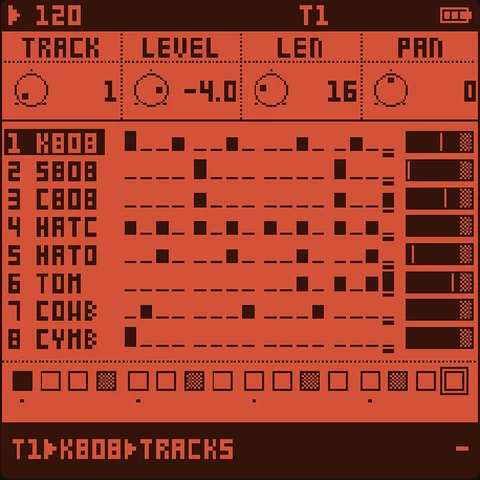
- A new screen look in the style of a classic digital drum machine's LCD, on every screen: two colours only (ink on a backlight; dither, dotted rules, inverted bars and title tabs instead of grey tones), a square pixel font with no smoothing, round knob dials with their values under them, shadowed popups. Layout: an inverted top bar, a compact knob row, the graph area, a trig strip with gaps between steps, and a breadcrumb (
T1>K909>SOUND). HOME: a main-screen strip under the top bar, four small knobs with values below and a large scope; TRACKS keeps everything it shows on dithered level boxes. MENU > COLOR now cycles four themes: MD RED (the default), RED ON BLACK, WHITE ON BLUE and BLACK ON GREEN (old colour settings map to the nearest). A new 1-bit logo on BOOT and ABOUT. The PRESETS popup and list, MENU, NAME, the Bluetooth page and every popup in the same style. Nothing that was on a screen before is lost.
0.21.0 - 2026-10-19
- Presets: a preset is a voice (MODEL and the 8 SOUND knobs), in banks MACHINEDRUM, CLASSIC, MODERN (151 factory presets) and USER (128 slots). The PRESETS encoder loads the next / previous preset onto the selected track at each detent, through every bank (empty USER slots and a capped ACID skipped), with a popup over the graph (the bank, the preset, two before and after; about 1.5 s).
- The PRESETS list: EDIT held about 0.4 s opens it (an EDIT tap as before; seven presets on screen). KNOB 1 / PRESETS move, KNOB 2 / SELECT pick the bank, and every move plays the preset under the cursor once on the selected track, which keeps that sound while the list is open (its key and the pattern play it). OCT+ LOAD keeps it and closes the list; EDIT or HOME closes it with the track's own sound back. SAVE stores the track's own sound (not the auditioned one) into the first free USER slot or the chosen one (a used one: SAVE twice), OCT- twice DELETEs. USER presets are named from the voice and the slot ("SDTRX 03"); saved while playing, they are written at the next STOP. While MIDI LEARN is on, EDIT held does nothing.
- Shown: the SOUND pages show the track's preset ("PRESET HOUSEBD") with
*once a SOUND knob moved, TRACKS' footer too; a track whose USER slot now holds another voice (or none) shows-. Projects keep each track's preset and its mark; older projects load with no preset, their sound unchanged. SAVE while MOTION plays stores the knobs as set, not motion's values. - The factory banks: MACHINEDRUM 55 presets read from the Machinedrum's factory kits (1 to 4 per voice; none for MATRX, CLTRX), CLASSIC 56 and MODERN 40 (4 per voice, ACID and SMPL included). Every voice's default sound is its first preset: unchanged for CLASSIC and MODERN, new for the 19 Machinedrum voices with presets (KTRX SUBTHUMP, SDTRX HARDSNAP, CPEFM BUZZCLAP, ...).
- No default choke groups: HATC, HATO, HMETL, HNOIS, CHTRX, OHTRX and HHEFM used to start in group 1. CHOKE is now only the track's own setting: a MODEL change or a preset load never changes it, so the power-on kit's HATC / HATO no longer cut each other until CHOKE is set on both. Older projects keep their stored CHOKE.
0.20.0 - 2026-10-19
Eight FM voices measured from a classic digital drum machine's FM family: from an emulator's renders, knob by knob; only the measured behaviour is used, no code or data of it. TUNE 0 is the machine's PTCH 64. All come after B2TRX in the MODEL list.
- BDEFM, XTEFM: an FM bass drum and an FM tom (1 voice each). BDEFM TUNE DECAY RAMP RDEC, MOD MFRQ MDEC MFB; XTEFM TUNE DECAY RAMP RDEC, MOD MFRQ MDEC CLIC. RAMP sets where the pitch starts (16 flat, below it the pitch rises, from 0 Hz at RAMP 0) and RDEC how fast it gets back; MOD the FM depth, falling over MDEC; MFRQ the modulator's pitch; MFB grit from about 40, noise at 127; CLIC a click at the start. XTEFM's FM is an approximation (its kind of grit, not its exact tone); with MOD 0 it is exact. Both end at 0.58 s at the top of DECAY, as KTRX.
- SDEFM, CPEFM, RSEFM: a snare, a clap and a rim shot (1 voice each), each a tone modulated by noise, the same on every hit as on the machine. SDEFM TUNE DECAY NOIS NDEC, MOD MFRQ MDEC HPF: MOD the noise FM's depth, MDEC its decay, NOIS / NDEC a separate noise burst (random on every hit), HPF a high-pass. CPEFM TUNE DECAY CLPS CDEC, MOD MFRQ MDEC HPF: the same FM restarted CLPS / 8 times at CDEC's spacing (1 .. 41 ms), then DECAY. RSEFM TUNE DECAY MOD HPF, SNAR SPTC SDEC SMOD: a rim and a second "snare" voice (SNAR its level, 0 = off; SPTC its pitch).
- CBEFM, HHEFM, CYEFM: an FM cowbell, hat and cymbal. CBEFM TUNE DECAY SNAP FB, MOD MFRQ MDEC: two FM tones, FB feedback, SNAP a fast extra decay (4.5 ms) that lowers the rest of the hit. HHEFM TUNE DECAY TREM TFRQ, MOD MFRQ MDEC FB: a sizzling FM hat, FB from a stalled tone to chaos, a tremolo restarting at each hit; choke group 1, as HATC. CYEFM TUNE DECAY FB HPF, MOD MFRQ MDEC: four FM pairs, MDEC from 0.28 to 11 s, HPF two high-passes (off at 0); 2 voices.
- DECAY: SDEFM, CPEFM, RSEFM, CBEFM, HHEFM and CYEFM follow the machine's whole 1.6 s range and fade out from 5.5 s at the top of DECAY. BDEFM and XTEFM stop at 0.58 s: a faded sub-bass tail sounds worse than a short one.
0.19.0 - 2026-10-18
Thirteen voices measured from a classic digital drum machine: from an emulator's renders, knob by knob; only the measured behaviour is used, no code or data of it.
- KTRX: a sine kick. TUNE DECAY SWEEP SDEC, PUNCH NOISE SUB CLIP: the pitch with its built-in drop; SWEEP a rise over SDEC; a short transient at the hit; PUNCH a square first cycle; NOISE a burst; SUB half-harmonics that fade on their own; CLIP a hard clip. DECAY runs from a 7 ms floor to 4 s (to -60 dB). 1 voice; the SOUND graph shows the pitch and the level over 300 ms.
- SDTRX: a snare. TUNE DECAY SNAP TONE, BUMP BENV CLIP: two tones, one at 342 Hz with BUMP's pitch blip (its time set by BENV), the other shaped by BENV; TONE crossfades them; CLIP a drive that eases off on its own (about 28 ms), whatever DECAY is; SNAP the same noise on every hit (above 64, a 1.44 kHz ring). TUNE moves both tones by semitones. 1 voice.
- B2TRX: the machine's second bass drum. TUNE DECAY RAMP HOLD, TICK NOISE DIRT DIST: a 50 Hz sine at TUNE 0, starting at 0 on every hit; RAMP added pitch; HOLD full level before DECAY's fall (up to seconds); TICK a click; NOISE a hiss; DIRT a coarse quantiser; DIST a hard clip. 1 voice.
- XTTRX, XCTRX, CLTRX, RSTRX: a tom, a conga, claves and a rim shot, 1 voice each. XTTRX / XCTRX TUNE DECAY RAMP RDEC, DAMP DIST DTYP: a click, then a sine whose RAMP adds pitch falling over RDEC; DAMP moves level from the body to the click; DIST a hard clip, DTYP making the clipped part sag. CLTRX TUNE DECAY DUAL ENH, TUNE2 CLICK: two pure tones (TUNE2 the second's pitch, TUNE moving both); DUAL delays the first, ENH raises it, CLICK a short click. RSTRX TUNE DECAY DIST: a sine and a click under one decay; DIST warps the sine (stronger at low pitch). TUNE 0 is each machine's PTCH 64; the other knobs are the machine's own.
- CPTRX, MATRX: a clap and maracas, 1 voice each; a hit sounds the same every time. CPTRX TUNE DECAY CLPY HARD, RATE ROOM RSIZ RTUN: four noise bursts (RATE their spacing, DECAY their decay, CLPY the first three's level), HARD a resonant low-pass, and ROOM a noise tail (RSIZ its length, RTUN its colour; 0: off). MATRX TUNE DECAY ATT REV, DAMP RATL TONE HARD: grainy noise (DAMP: sparser), a rattle that grows through the hit (RATL), an attack (ATT), a hold (DECAY) and REV's dip and second hold.
- CBTRX, CHTRX, OHTRX, CYTRX: a cowbell, closed and open hats and a cymbal; the hats and the cymbal share one bank of metallic oscillators. CHTRX / OHTRX TUNE DECAY GAP HPF LPF MTAL (MTAL from noise to metal; DECAY a hold, GAP the decay after it; OHTRX's long hold dips to silence and comes back, as the machine's); choke group 1, as HATC / HATO. CYTRX TUNE DECAY RICH TOP TTUN SIZE PEAK (RICH the oscillators' balance, PEAK a 5.2 kHz bell, SIZE the body, TOP / TTUN a brighter top that fades first; 2 voices). CBTRX TUNE DECAY ENH DAMP TONE BUMP PTCH (two tones, ENH a resonator and grit, DAMP a narrow band-pass).
- MODEL list: the new voices come after ACID: KTRX SDTRX XTTRX XCTRX CPTRX RSTRX CBTRX CHTRX OHTRX CYTRX MATRX CLTRX B2TRX.
0.18.0 - 2026-10-14
- MIDI LEARN: up to 16 CCs from any controller, each set to one knob of one track. Hold GLO (the MUTE screen) and press G4 to turn it on; turn a knob of the selected track (HOME, EDIT, LAYER, FILTER, FX, SLICER, RESON, LFO, PATTERN, TRACKS' LEVEL / LEN / PAN), then move the controller's knob:
CC74 -> T3 DECAY. The footer shows what is picked and its CC. The CC moves that track's knob whichever track is selected, from USB, TRS or Bluetooth in MIDI mode (not SMC DAW mode), on any channel, over the knob's whole range (centred knobs 0 at 64, lists by step); an LFO on the knob keeps modulating around it. One CC per knob, one knob per CC; CC 0, 32 and 120..127 are never learned. While on, OCT- clears the picked knob's CC (nothing picked:CLEAR ALL LEARNED?), OCT+ ends it. Saved in the FM-1 (not in projects) after each change once stopped; off at power-on. - MIDI LEARN actions, 32 controls: while LEARN is on, PLAY, REC, ALGORITHM right / left (NEXT / PREV TRACK), FX + a black key (a PERFORM effect) and FX + a white key F3..F4 (that track's PERFORM mute) pick their action instead of doing their job; a PERFORM knob (FILTER CRUSH THROW DEPTH) picks its macro. A CC or a note is bound to an action (
NOTE36 -> PLAY,CC22 -> FX R1/16), a CC to a macro (CC20 -> FX FILTER, 0 at 64). A press (a CC rising to 64 or more, a note on) taps PLAY / REC or steps the track; a PERFORM effect or mute is held while the controller's button is, and ends on release or when the menu, a confirm, NAME or the MUTE screen comes up. A learned note plays no drum. 32 bindings (was 16); the 16 saved before load as they were.
0.17.0 - 2026-10-13
- SELECT turns the pages: SELECT does what PRESETS did (a section's pages, HOME 1/3 to COMP 2/3 and 3/3, the page under PERFORM, the menu's cursor, the Bluetooth page's rows), except on HOME's TRACKS mode, where it sets the tempo. PRESETS does nothing; ALGORITHM still picks the track.
- HOME has two modes: TRACKS (the mixer: TRACK LEVEL LEN PAN, the steps on the keys) and HOME (the scope, the selected track's knobs, the compressor after it). A HOME tap on HOME switches between them; from elsewhere it opens the one last shown; power-on shows TRACKS. REC no longer opens TRACKS.
- REC arms on every screen: a REC tap arms / disarms the selected track (arming while stopped starts play;
STOP TO EDITduring a song). Kept: step record on STEP with KEYS on and stopped, and REC held for CLEAR TRACK on SEQ, DELETE ROW / CLEAR SONG on SONG. REC is no longer the mute modifier. - The MUTE screen (GLO held): the eight tracks as boxes, filled = heard, outline = muted, a waiting mute blinking, the key under each; the white keys F3..F4 toggle them, the top C# / D# set MUTE: NOW / NEXT BAR. A GLO tap still opens GLOBAL. Replaces REC held + a key.
- PERFORM knob effects stay on: FILTER, CRUSH, THROW and DEPTH keep working after FX is let go or the PERFORM page closes, on every page, until turned back to 0 on the PERFORM screen (or TOOLS
INIT*). An amberFXin the top bar shows while any is on. The black keys' effects still stop when let go. - The last project loads at power-on: every SAVE remembers its slot, and at power-on (not in a safe start) it loads, stopped. If it can't,
LOAD FAILED: SLOT n/START NEW PROJECT?: YES forgets the slot, NO asks again at the next power-on; both carry on with the power-on kit. - Metronome: GLOBAL 3/3 METRO OFF / LOW / MID / HIGH (a device setting, not in projects). While playing, a click on every quarter note, higher on the bar's first, after the PERFORM effects and at the MASTER volume, on the speaker, the headphones and USB audio.
- CPU and PRIO: voices are shed at 95 % of an audio block (was 85 %). PRIO per track (EDIT, after CHOKE): HIGH / LOW; a LOW track's voices go first at a shed and at the voice cap (a held ACID note still last). A red CPU icon shows in the top bar for 2 s after a shed.
- Projects: older projects load as before, every track PRIO HIGH; projects saved by this version can't be read by 0.16.0. A slot whose save to flash failed (its project only in memory) is not carried over.
- Key backlight: MENU BACKLIGHT OFF / ON (a device setting, default OFF). ON: every unlit key glows at about 5 %, and the unlit steps 1, 5, 9 and 13 of the bank shown at about 25 %, marking the beats on every screen where the keys are the selected track's steps (STEP, PATTERN, MOTION, SONG; HOME's TRACKS mode while no track is armed); lit keys stay full, the buttons unchanged.
- Going back: going back to an older Hortator with the last project, METRO or BACKLIGHT set: its SPEAKER EQ reads FLAT.
- Bluetooth version: AUTOSTART OFF / ON on the Bluetooth page (after BLUETOOTH; KNOB 1 right ON / left OFF, OCT+ toggles; saved when the menu closes; default OFF). ON: 5 s after power-on, Bluetooth starts by itself as if BLUETOOTH ON were chosen, and reconnects to the remembered device. Not in a safe start (SEQ held). If the last Bluetooth start before this power-on did not complete or ended in an error, it is skipped and the top bar says
BT AUTOSTART SKIPPED; BLUETOOTH ON by hand still works. Going back to an older Hortator with AUTOSTART ON resets its display settings (COLOR, SPEAKER EQ, ZOOM, KNOB ACCEL, USB LEVEL, PERFORM) to their defaults once.
0.16.0 - 2026-10-11
- ACID: every step holds a note, SLIDE and TIE; drum tracks play their steps transposed. ACID, a 303-style bass voice (TUNE DECAY CUTOF RESO ENVMD ACCNT WAVE GATE), plays them with accent, slide and tie on up to two tracks ("ACID: 2 TRACKS MAX"). Older projects load and play as before, but projects saved by this version can't be read by 0.15.0.
- KEYS (an SCL tap): the keys play the selected track chromati