
The Firmware Hub · FM-1 · Scintilla
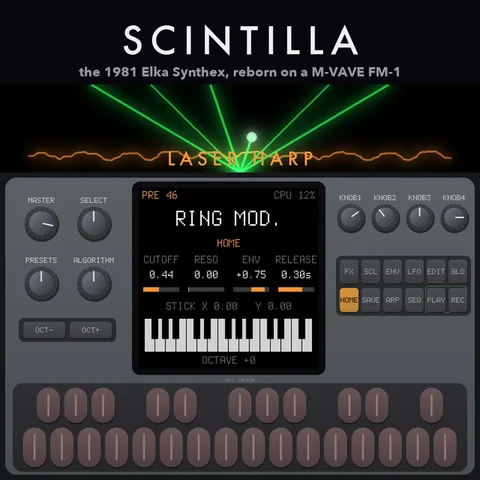
Scintilla0.3.2 · beta

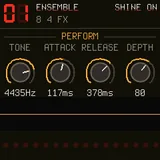
The 1981 Elka Synthex on the FM-1: all 80 factory sounds, Paul Wiffen's laser harp among them, checked sample by sample against the original. Two layers of 8 voices (single, split, double), poly, mono or unison, chorus and reverb, and the four knobs edit what is on the screen.
Text by the maker.
About it
- Engines
- Analog / VAIts own: Elka Synthex voice
- Runs on
- FM-1
- Release
- 0.3.2 · released 12 Nov 2026 · on the hub since 1 Nov 2026596 KB · what's new
- Licence
- GPL-3.0 · source ↗ · copy on the hub
- Flash chip
- Every FM-1, the newer chip
0xB36014too - Identity
FM-1_96300302what it reports over USB while it runs- Build
- Built by GitHub Actions from c9465b4, signed
- Popular
- ↓ 109 installs via the hub · ★ 2 on GitHub
Ratings
Family
More by Joakim Eriksson
Like Scintilla

Changelog
What changed, version by version6 versions
0.3.2 (2026-11-12)
Identity FM-1_96300302.
- The hard hit at the start of a note. Laser Harp (Ring mod.) and the other plucked presets (Chunky Synth, Funky Clav., Clavichord II, Bass pluck) began each note too bright: their filter envelopes swing far past the top of the filter's range, and the filter stood wide open at 16.7 kHz for the first 20 ms. The recording of the instrument has it top out lower, and a second Synthex on the same preset agrees: the filter now opens no further than 8.4 kHz. Measured on an SMK-37's own audio against the recording, the treble of a Ring mod. note's first 30 ms went from 4.8 dB over to about 2 over. The forty PRESETS' onsets above 3 kHz: 6.1 -> 5.1 dB from the recording's.
0.3.1 (2026-11-11)
Identity FM-1_96300301.
- Newer FM-1s. The units sold since autumn 2026 carry another flash chip, a UC25HQ80 (JEDEC 0xB36014), where the first ones have a Puya P25Q80 (0x856014). Scintilla knew only the first: on a newer FM-1 its loader refused the install, and had it run there it would have kept its settings in RAM only and refused the updater. It accepts both now, as Dinghy 0.5 does (
FL_JEDEC_OK; the driver uses only generic SPI NOR commands). In fm1-emu posing as the newer chip, 0.3.0 leaves no settings record in the flash and 0.3.1 writes it; not tried on a newer FM-1 itself.
0.3.0 (2026-11-11)
Identity FM-1_96300300. The second round of tuning against the recording of the instrument, this time from Elka's schematics too: the story, preset by preset. The forty PRESETS' mean distance to the recording went from 6.3 dB (0.2.0) to 4.9.
The sound
- One LFO per layer, as the Synthex has (its LFO board, and the firmware's key-assign routine): it runs whether or not a key is down, every voice of the layer in step, and a key restarts it, with its delay, only when no other key of the layer is held and the preset has an LFO delay. Until now every voice had its own, stopped while the voice was silent, and the delay played once, at power-on: Whistle's and the strings' vibrato now fades in at the start of each phrase, and Landing's slow sweep carries on across notes instead of starting again in each voice.
- Both LFO depth knobs of the ROM presets read inverted, as the LFO board's circuit says and the recording confirms: the organs' tremolo is a fifth of what it was (Church organ, Reed organ: 1 dB of ripple, not 4-5), Tremolo piano's and Electric piano II's a little deeper, the pulse-width sweeps of Chorale, Clavinet and the sweeps follow the inverted knob.
- The ring modulator is the Synthex's own, from the voice board's schematic (410CST5800), as synthex-web's now is: not a multiplier but the XOR gates in front of an oscillator's waveform DAC, which invert the wave while the other oscillator's pulse is high. The Laser Harp (Ring mod.) no longer starts its low notes with a hard click: the product of the two coupled oscillators was 8 dB louder for part of each cycle, a treble burst 10-14 ms into the note, 11 dB over it where the recording of the instrument has 3 (now 3). Clavichord II and Landing, the other two presets with it, come closer to the recording (4.3 -> 3.0 dB and 10.0 -> 8.2); Ring mod.'s sustained spectrum is 0.5 dB further (2.9 -> 3.4). It costs: Ring mod. x8 54 -> 62 % of a core, Landing 58 -> 67 %.
- Cross-mod (the Laser Harp, Landing, Metallic, Fat Sound) takes what the same schematic shows: not the other oscillator's output pulse but the wave in front of its pulse comparator, a triangle (on the ringed oscillator, the ramp as the other pulse flips it), at the depth the comparator's two resistors give. All four come closer to the recording: Ring mod. 3.4 -> 2.9 dB (where it was before the ring modulator's change, now without the click), Landing 8.2 -> 7.6, Metallic 6.3 -> 4.0, Fat Sound 4.2 -> 3.5. It costs 2-3 % of a core on those presets.
- Three ROM presets corrected against the recording of the instrument, as synthex-web's bank: High pass sweep (filter envelope at half its decoded amount, cutoff 8 semitones lower), Filtered brass (envelope x 0.7, cutoff 6 semitones higher) and Clavichord I (envelope x 0.7, cutoff an octave lower).
- The oscillators reach the mixer and the ring modulator through a 5 Hz coupling, as synthex-web's now do: a narrow pulse's DC (2 pw - 1 of it) no longer thumps under every note (Brass II, Funky Clav., Electric piano I, the clavichords, Metallic piano, Pianet, Sweep 1). It costs ~18 instructions a voice-sample: Chunky Synth x8 19 -> 22 % of a core, Ring mod. x8 51 -> 54 %.
- The ROM bank, as synthex-web's retune: full key tracking is 1.0 semitone per key (it was 0.81), and the filter envelope's sustain 0.7 of its knob. Measured on held notes at the start of each preset's passage in the run-through; the organs, Pianet, Ceilos, Double basses and Brass II gain most, Electric piano II loses.
- Filtered chorus's filter envelope at 0.7 of its decoded amount: its notes open 12-15 semitones less, as on the run-through.
The firmware
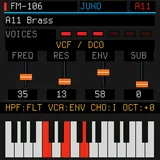
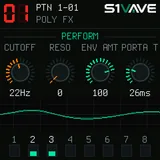
- Every parameter the engine plays is on a page now (26 pages, 90 parameters), as PROPHET's in fm1-dock: a row for each knob, its name, its value and a bar. HOME keeps its columns and the keys.
- A page button held for 0.4 s goes back a page; the screen shows where in the group you are.
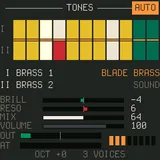
- LAYERS: edit the upper, the lower or both layers; make a sound single, split (at a note) or double; its voices.
- The sustain pedal (MIDI CC 64, the Synthex's HOLD), from USB and the DIN jack.
- CC 71 resonance, CC 72 release and CC 73 attack (both envelopes), as PROPHET's; CC 70 the cutoff.
- On fm1-dock's SMK-37: FADER BANK gives its faders (CC 70..73) PLAY, FILTER ENV, AMP ENV or MIX; KNOB BANK picks the layers the knobs edit; < > step through every page.
- The OUTPUT page's TUNE knob is gone: neither the engine nor synthex-web plays the master tune.
- The pages are numbered anew: the page saved by 0.1 or 0.2 opens as the same page.
- The pitch routes (LFO to OSC 1 / OSC 2, ENV1 to OSC 2) turn by ratios and show three decimals under 0.1: the presets' vibratos are 0.005..0.04.
- Fixed: the stick turned right (ALGORITHM, or STICK X) did not reach the sound since 0.2's aftertouch: LFO 2 into the filter did nothing.
0.2.0 (2026-11-01)
Identity FM-1_96300200. Everything here follows synthex-web, the reference, and is checked against it (tests/run.sh).
The sound
- The ROM bank: the 40 PRESETS now carry the values decoded from the Synthex's own EPROMs, with envelope reach, LFO pitch depth and PWM depth measured on a recording of the real instrument. Many sounds change.
- The chorus as the schematic has it: two bucket-brigade lines, triangle LFOs at 0.49 Hz and 0.60 / 4.6 Hz.
- Band-limited hard sync, a phase-derived triangle, VoiceCore's resonance curve.
- An exponential release, and the falling ramp as an LFO shape (RAMP-).
- Take-off starts without its click: its filter envelope is corrected, the cutoff is followed within a block, and a voice retriggered while it sounds keeps its oscillator phases.
- The amp envelope starts 1.5 ms after the filter envelope.
The firmware
- Velocity and aftertouch from the FM-1's own keys, on a SETTINGS page (GLO twice); off until you turn them on.
- MIDI CC 7 is the volume. The DIN jack's UART is latched as in Dinghy 0.4.
- A page with Install on my FM-1: <https://joakimeriksson.github.io/scintilla-fm1/>.
- Releases are built and signed on GitHub by the Firmware Hub's shared workflow.
The cost
- Fast filter attacks are about half as dear: eight voices struck again and again on the heaviest patches went from ~125 % of a core to ~70 % (-Os, as fm1-dock builds it). This firmware renders on one core; fm1-dock's module shares the voices between two.
- The cutoff tracking and the new oscillators cost a few points on held chords: Metallic 52.7 -> 56.8 %, Ring mod. 47.6 -> 50.9 %.
Fixed in the tests: tests/run.sh never compared the staged render with the per-sample one (a misspelt define); it does now, and they are equal on every preset.
0.1.1 (2026-10-23)
0.1 with its own identity: FM-1_96300101 (0.1 reported FM-1_960, which SID-1 also uses).
0.1 (2026-10-23)
The first release: the 80 factory sounds on the FM-1, two layers of 8 voices, chorus, an algorithmic reverb, the knobs and pages, MIDI over USB and the DIN jack.